

Introduction
As a landlord in Dubai, staying updated with the latest tenancy laws isn’t just a legal obligation — it’s a strategic advantage. With the 2025 updates to the Dubai tenancy law, landlords now face both greater responsibilities and clearer protections. Whether you’re managing one apartment or a portfolio of rental units, this guide will walk you through your legal rights, obligations, and the new regulations introduced by RERA and the Dubai Land Department, including the important aspects of Dubai tenancy law 2025.
This guide covers everything you need to know: from tenant eviction rules to rent caps, Ejari registration, and dispute resolution.
This guide also highlights the implications of the new Dubai tenancy law 2025 on rental agreements and tenant rights.
Overview of Dubai Tenancy Law (2025 Edition)
What is Dubai’s Tenancy Law?
The Dubai tenancy law, governed by Law No. (26) of 2007 and Law No. (33) of 2008, is the regulatory framework that governs the relationship between landlords and tenants in Dubai. These laws are supplemented by RERA regulations, and enforced through the Dubai Rental Dispute Center (RDC).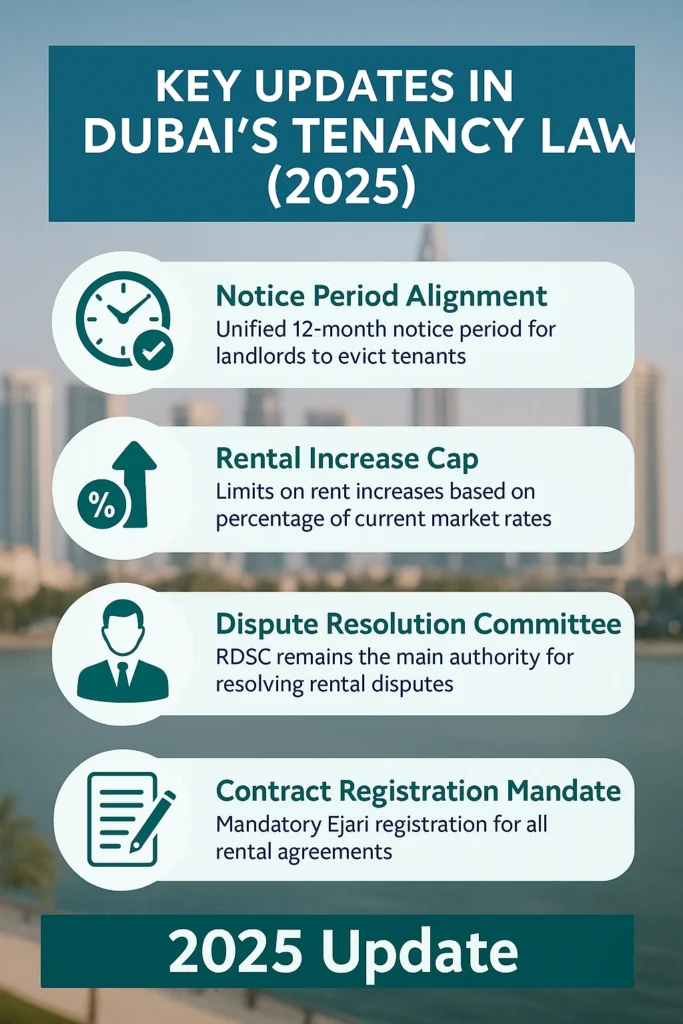
Who oversees tenancy laws in Dubai?
- RERA (Real Estate Regulatory Authority): Regulates property rental laws and sets guidelines.
- Dubai Land Department (DLD): Handles Ejari registration and documentation.
- Rental Dispute Center (RDC): Acts as the judicial arm for disputes between tenants and landlords.
Key 2025 Updates to Dubai Tenancy Law
- Mandatory Digital Ejari Renewals
Landlords must now complete Ejari renewals online through the Dubai REST app. Physical submissions are no longer accepted.
- New Rental Increase Calculator Rules
The DLD’s rental calculator is updated to reflect current market trends. In 2025, if your rent is:
- ≤10% below market rate → No increase allowed
- 11–20% below market rate → Max 5% increase
- 21–30% below market rate → Max 10% increase
- 31–40% below market rate → Max 15% increase
- >40% below market rate → Max 20% increase
- Notice Period for Non-Renewal Extended
Landlords must now give a minimum 12-month notice if they choose not to renew the lease, including reasons like personal use or sale of property.
- Eviction Grounds Must Be Documented
Eviction notices must now be served through Notary Public or registered mail, and supported with documentation.
- New Penalties for Discrimination and Harassment
Discriminating against tenants based on nationality, gender, or religion is punishable by fines under the updated RERA Code of Ethics.
Rights of Landlords Under Dubai Law
✅ You have the right to:
- Receive rent on time as agreed in the lease.
- Request security deposits and deduct damages.
- Increase rent within RERA’s rent cap framework.
- Evict tenants based on legal grounds with 12-month notice.
- Access the property for maintenance with proper notice.
❌ You cannot:
- Enter the unit without tenant consent.
- Shut off water, electricity, or services.
- Evict tenants without valid cause and notice.
Common Legal Obligations for Landlords
| Obligation | Requirement |
| Ejari Registration | Must be completed online within 30 days of lease signing |
| Maintenance Responsibility | Landlord responsible unless contract states otherwise |
| Security Deposit Handling | Return at end of lease unless deductions are proven |
| Written Lease Agreement | Mandatory for all tenancies, stating terms and payment details |
| Notice Period for Changes | Must give 90-day written notice to amend lease terms or rent |
Lease Renewal and Rent Increase Rules
When can you increase rent?
Rent increases are only allowed after 90 days’ notice, and must comply with the DLD’s rental index.
Example:
If your current rent is AED 60,000 and the market rate is AED 75,000:
- 75,000 – 60,000 = AED 15,000 difference
- 15,000 ÷ 75,000 = 20% below market rate
- ✅ You can raise rent by maximum 10%
Can tenants dispute rent increases?
Yes. Tenants can file a complaint with RDC if they believe the increase is unfair or unlawful.
How to Legally Evict a Tenant in Dubai
You can legally evict a tenant after the lease term ends and only for valid reasons:
| Eviction Reason | Conditions & Requirements |
| Personal Use of Property | Must provide 12 months’ written notice, notarized or registered |
| Sale of Property | Must notify tenant 12 months in advance |
| Breach of Lease Agreement | After 30-day warning and no correction from tenant |
| Failure to Pay Rent | After 30-day payment notice |
⚠️ Important: You cannot evict a tenant mid-contract unless there’s a legal breach or reason defined under RERA law.
Rental Disputes: Where to Go
All rental disputes in Dubai are handled by the Rental Dispute Center (RDC).
RDC Process:
- File complaint via Dubai REST App or in person.
- Submit required documents: Ejari, lease, notices, proof of payment.
- Pay AED 100 admin fee + 3.5% of annual rent (max AED 20,000).
- Case reviewed and judgment issued within 30 working days.
Maintenance Responsibilities: Who Pays for What?
- Landlord typically pays for major structural issues (pipes, AC, water tanks).
- Tenant pays for minor repairs and daily wear and tear.
However, lease agreements can override defaults, so ensure the contract specifies who handles:
- Chiller or cooling fees
- Air conditioner servicing
- Pest control
- Painting and touch-ups
Best Practices for Landlords in Dubai (2025)
- Always issue written notices via registered channels.
- Use the Dubai REST App to manage all leasing transactions.
- Keep a digital record of all communications and documents.
- Provide detailed inspection reports before and after tenancy.
- Conduct periodic property condition checks.
FAQs About Dubai Tenancy Law (2025)
Q1: What is the notice period for landlords to evict a tenant in Dubai?
12 months’ notice is required for eviction due to personal use or sale, served via registered mail or Notary Public.
Q2: Can I increase rent at the end of the lease?
Yes, if it’s allowed by the RERA rental calculator and you’ve given 90 days’ written notice before lease expiry.
Q3: How do I register Ejari online?
Use the Dubai REST App or visit an authorized typing center. Documents needed include Emirates ID, title deed, and signed lease agreement.
Q4: What happens if the tenant refuses to vacate after eviction notice?
You can file a case with the Rental Dispute Center (RDC). If you’ve followed legal notice procedures, the eviction will be enforced by court order.
Q5: Who pays for AC maintenance in a rental unit?
Unless specified in the lease, landlords are responsible for major servicing and breakdowns, while tenants may handle filters or minor tasks.
Q6: Can a landlord terminate a lease early?
Only if the tenant breaches the agreement, fails to pay rent, or damages the property — and even then, a 30-day warning notice is required first.
Related Articles
Conclusion
Understanding and applying Dubai’s 2025 tenancy laws gives landlords a clear edge in managing property risks, tenant expectations, and legal compliance. By aligning your practices with RERA standards and digital tools, you can avoid disputes, maintain profitability, and offer a better tenant experience.
Explore more Dubai landlord tips
Looking to simplify your landlord journey in Dubai?
👉 Visit our PM Insider for actionable insights, legal updates, and expert property advice.